Business-IT alignment

Alignment of business and ICT – an expression which entered the business and ICT vocabulary in the 90’s or thereabouts.

  • Has the expression passed its use-by-date?
  • What are the risks in using this expression?
  • What is being aligned to what?
  • Is alignment what we really need?
  • Is alignment what we really mean?

We all know that we shouldn’t align business to ICT, but do we really want to align ICT to business?

The effective use of ICT by different stakeholders in the market / environment in which an enterprise operates means that existing business models are being made irrelevant and redundant, impacting on the viability and sustainability of our enterprises.  In reconsidering the business model(s) upon which our enterprises are based, the incorporation of ICT capabilities offers wider choices.  Market demands may also be such that the only viable models are those incorporating particular ICT capabilities.

In such scenarios, it is no longer a case of “aligning” business and ICT – it is a case of facing no choice but to transition to ICT enabled business models.  This means that the resultant business and change strategies will require particular business and ICT capabilities as critical to realising the intended business model and associated goals, and ensuring the ongoing viability and sustainability of the enterprise.

The identification of critical business and ICT capabilities occurs as an intrinsic element of business strategy development, such that there is no subsequent “alignment” process to pursue.  There is simply the further development and execution of the change strategy to transition to the desired business model and associated operating model.
System, capability, process

For a long time, I have been involved in modeling “systems”.  It first started with modeling parts of how a police force operates and enabling senior officers to identify areas where improved performance was needed.  I then gained experience in modeling port, rail and mining operations.  Here, my models were used to represent future capabilities and to assess different proposals for improved capability in terms of their contribution to improved enterprise capacity.  This was my first exposure to enterprises-as-systems and modeling these systems.

Then I moved into the world of health services, in particular hospitals and the laboratories providing information to inform diagnosis and treatment.  Now, I had moved into the world of modeling enterprise-information-systems rather than modeling enterprises-as-systems.

Wind the clock forward another thirty years, and now I am modeling enterprises and their use of information systems, and helping enterprises to better understand these systems – their enterprise and their information systems.  I started with a process perspective and have done quite a lot of enterprise modeling in the enterprise-as-process space, creating a process breakdown structure providing a series of stepping stones from one process (the enterprise) to roughly 200 key processes in an enterprise such that the connections between the processes are better understood.

In my mind, I could look at a process and see that as a representation of the process, the people involved, and the other resources involved.  But a colleague could not do that. She pointed out that “capability” is the representation of process plus the resources used to exercise the process.  This was the beginning of my journey through enterprise-as-capability.

And it has been my experience that in using the capability lens, that the most traction has been gained in engaging with senior executives.  This is the means by which I can engage in conversation about:

  • business capabilities necessary to fulfil business strategy
  • business capabilities implicit in any business strategy
  • capacity of current business capabilities to realise the demands of the business strategy
  • dependencies on other business capabilities and on technical capabilities

It has been an interesting journey, and the recent connection of capability and process as perspectives of system has been invaluable.

Enterprise performance, productivity & competitiveness

I have lost count of the number of times that I have heard people complain about how IT is undervalued, how the CIO deserves a place at the Executive table or at the Board table.  All too often this is because the proponents are unable to clearly and succinctly articulate the value proposition for the CIO function or for the more effective use of IT by an enterprise.

Combined with this, I also have lost count of the number of times that I have seen Board members eyes glaze over as soon as someone mentions that awful word “IT” or any of the associated technobabble.  Yet, these same people are often worried about the future of their enterprise and the impact of significant changes in the markets in which they operate, sometimes due to the capacity of their competitors to make more effective use of IT than they are able to!!

So, I have taken an interest in exploring and discussing these problems from a different angle, such as whether an organisation needs to be more innovative, and if so, how this might be achieved.

And in doing so, I have found that this brings me back to understanding enterprise performance, staff productivity and enterprise competitiveness.  Often times this then leads to thinking about the capabilities required by the enterprise, their adequacy for current and future demands, and ways in which the performance of particular capabilities can be improved.

Enter process innovation!

That is, here is where enterprise modeling comes and adds some value, by enabling an enterprise view of current and future capabilities and identifying the gaps, whether missing entirely or simply not performing adequately, identifying where the performance gap is and determining innovative ways of addressing this gap, sometimes involving process innovation.

And so, it has become increasingly evident to me that process innovation has a place in contributing to improved enterprise performance, improved productivity and increased competitiveness, and enterprise modeling offers tools, techniques, thinking models which enable an enterprise to tackle these sort of questions, these sorts of demands, these sorts of business change and transformation, most often combined with some commensurate systems transformation!

More business, less technical?

Enterprise modeling (or enterprise architecture) started off in the technology world, with the CIO and others needing to make sound investment decisions about enterprise wide infrastructure (such as mainframes, networks, etc).  These decisions involved resources which would support multiple change initiatives and where it would be “unfair” and “unjustifiable” for the initiating project to bear the full cost of the resource.  Equally, there was a need to ensure that these enterprise wide and longer-term investments would prove to be sustainable investments in situations where future project requirements were not well defined or understood.  Hence, the strong technical focus during the “childhood” years of enterprise architecture.

In its adolescent years, enterprise models incorporated business models AND technical models, such that the technical investments were informed by business considerations and were more “business aligned” or “business driven”.

In the early adult years (now), greater attention is being given to modeling business capabilities over technical capabilities.  Further, business architects are being more strongly valued and technical architects are being found  to be deficient in meeting the enterprise modeling needs in rapidly changing times, where businesses need to be able to respond to market disruptions in much shorter timeframes than was previously the case.

In such an environment, questions are starting to arise as to the balance of effort between modeling the business capabilities versus modeling the technical capabilities.   I recently indicated that I expected the demands for technical modeling would reduce due to greater use of “cloud services”, and then was given cause to provide the following explanation for why I thought so.

With the increasing alignment between business and technical capabilities, there will be less need to architect the technical capabilities. These will progressively become tightly defined capabilities which can be easily and effectively used by business capabilities.

Business agility will come through the flexibility to mix and match business and technical capabilities to meet changing market needs. Put a different way – agile businesses will become plug-and-play business capabilities with the supporting technical capabilities being enablers rather than barriers – architecture is needed moreso when there is poor alignment.

What do you think?

An invaluable pattern

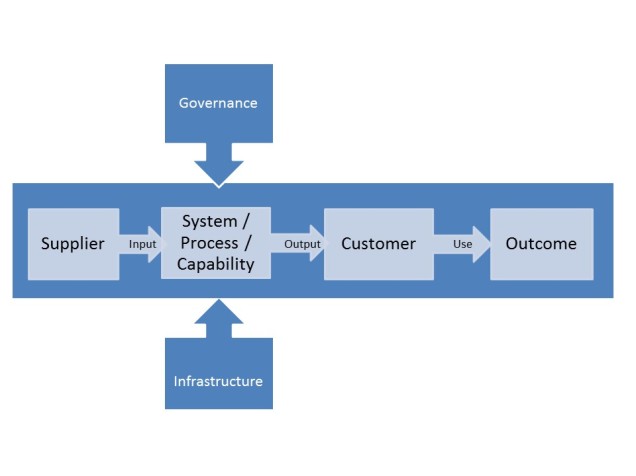
One of the most useful patterns (models) in enterprise modeling can be summarised as SICOCUO.

SIPOCUO For those who are familiar with IDEF0, you will be familiar with IPO – input, process, output

For those who are familiar with Six Sigma, you will be familiar with SIPOC – supplier, input, process, output, customer

SICOCUO is a further extension of this thinking, firstly be extending beyond customer to include use, outcome

An important element in the design and delivery of an output is an understanding of its prospective use by the customer and the outcomes realised through this use.  The simplest way to describe this is in terms of an car manufacturer and a purchaser of a car. The intended use by the customer – whether to transport a family, to participate in a car rally, or to distribute bales of hay to livestock, dictates a range of the features and characteristics which need to be designed into the car and which influence the processes (and capabilities) required to deliver cars which will be valued (and hence purchased) by prospective customers.

Hence, the extension of SIPOC to SIPOCUO.

SICOCUO is a variant to SIPOCUO in as much as it treats the focus as a capability rather than a process.  By focusing on a capability, appropriate attention to be given to all elements required for the effective performance of the capability and hence the organisation deploying this capability.

Hence, the final formulation:

  • Supplier
  • Input
  • Capability
  • Output
  • Customer
  • Use
  • Outcome

This pattern can be used at any level of an organisation.   It is quite valuable in distinguishing the responsibility of CXO and LOB Execs to realise the benefits from using a system versus the responsibility of the CIO to deliver a quality system.  It is equally valuable in positioning the current operation of an enterprise, its overall outputs (products or services) and the outcomes sought by its chosen customer segments.

Where to start

In my experience, the best place to start is to model enterprise capabilities.   Current indications are that significant interest exists in modeling, analysing and designing business capabilities.

One of the key features of this approach is that it can be undertaken using a breakdown approach.

  • Level 0 represents the enterprise as a single capability.
  • Level 1 capabilities are the standard split of governing, value adding and enabling capabilities
  • Level 2 capabilities are those required to support each of the level 1 capabilities
  • Level 3 capabilities are those required to support each of the level 2 capabilities, etc

In this way, working with people who know the enterprise well, it is easy to construct a capability model, either of the current or the proposed enterprise operating model.

This allows the governing body and executive management to assess the suitability, strength and sustainability of each capability, from there developing an enterprise improvement agenda, with clarity in relation to the investment required and the benefits / outcomes expected and, if well managed, realised.

Modeling the enterprise market

It seems that there are a wide range of Board members (directors of companies, government enterprises and not-for-profit entities) who are unable to conceive / appreciate the nature of the disruption that is likely to / will inevitably occur in their market place – disruptions caused by innovative adoption of IT by others. This is not about knowing more about IT. It is about being able to picture and imagine a different operating model in their marketplace.

In a completely different context, my Church Council was discussing future directions. One Council member suggested that we pose the following question to members of our faith community – what are your hopes and dreams for how this faith community might make a difference in people’s lives in 10/15 years’ time. Another member who makes some of the most valuable contributions to the thinking of our Council responded to say she could not think that way. She could not conceive of what life might be like in 15 years time and then work back to the implications for now. Having said that, she was one of the first to “get” the fact that the world has changed and our community has not changed, but needs to respond to the changing world. She can work forward incrementally and deal with the necessary change in that fashion, but cannot use her imagination to jump forward 15 years. Some can, some can’t. It is not a reflection of an inappropriateness or unsuitability for governance. It is the different ways in which our minds work.

In a different space, exploring IT enabled innovation, I have become alert to one of the key issues facing Boards and Governments being that IT enabled innovation is disrupting businesses and marketplaces all over the world.

Yet there is an amazing inability of some people, even some for whom one might have the highest regard, to conceive of the nature of the disruption that will occur and the impact for their organisation. This is not about technology or technical knowledge. It is about the ability to imagine and conceive of completely different operating models being adopted by competitors which will radically change marketplace dynamics. It is an inability to observe patterns in other marketplaces and to conceive of the implications for the marketplaces in which they operate.We need to find ways to activate the collective imagination of Boards and Governments to better perceive changes which will inevitably occur in the markets in which they operate (whether commercial or non-commercial markets).

What better way than to model the markets in which we operate and regard them as the enterprise.  In that way, we will identify capabilities needed by the market and the opportunities to position our enterprises to meet changing market operating models and their associated market demands.

Governing the Murray Darling Basin

Understanding the value of enterprise modeling is best achieved through practical examples.

Here is an approach to applying enterprise modeling and governance thinking to an important national challenge in Australia – the Murray Darling Basin, a significant river system upon which a significant segment of our nation is dependent for positive economic, social and environmental outcomes.

What is apparent to me and I assume to some but not to others is:

  1. The Murray Darling basin is a significant area of economic, social and environmental activity in the life of our nation. I don’t have the statistics at hand, but it does contribute a recognisable amount to our GDP and it does support a significant population. It is a significant environmental asset. These figures have been quoted and are readily available.
  2. There are other significant communities beyond the bounds of the basin that rely on the continued viable operation of this river system. Typically this is a reliance on water supplies.
  3. If the communities that exist within this geographical area and those outside the area continue to behave as they currently are (and have for the last x decades), it is evident that the river system will collapse and all the communities will suffer. Hence, change is mandatory – there is no choice.
  4. There are many communities who are unwilling to make the currently proposed changes. They claim that the proposed changes will impact on them economically and socially, and reject the changes on this basis. Yet, if no change occurs then all will suffer economically and socially. So, the choices are between no change (unacceptable), insufficient change (unacceptable), some change (necessary but not yet acceptable). It appears that there is insufficient recognition of the degree of change needed, especially when that change impacts local communities – yet the local communities will be impacted even more by no change or insufficient change.
  5. It is in this context, that we need new thinking models to enable appropriate decisions to be made, lest we make no decision and all suffer the consequences.

One thinking model which might help to approach the problem from a different angle, entails the following:

  1. The Murrary Darling Basin is a signficant national asset
  2. The MDB needs to be more appropriately “governed” – the current model of partnership between State Governments is clearly not working – it is evidence of failed governance.
  3. A new governance arrangement would benefit from taking a “portfolio management” approach to this valuable national asset. That is, to manage the asset in a way which generates the greatest value to the asset owners, operators and those that rely on this asset. Portfolio management simply applies the governance concept to the defined resources involved in the portfolio.
  4. A little known fact (as I understand it) is that our national Constitution which creates a Federation of states (and territories) is designed in such a way that it makes it very difficult to reduce or remove any states. (This comes from thinking and reviewing our three levels of government, and asking whether we could remove the second level – the answer is that it is virtually impossible to do). However, it is designed in a way that makes it relatively easy to add more states.
  5. What if Australia was to create the new Murray Darling State? This state would have a geographical boundary that aligns with the Basin perimeter ie the primary area that is the source for the river system, and the communities that are within this boundary. The new state would involve excising these areas from Qld, NSW, Vic and SA. I imagine that ACT would remain a separate territory.
  6. Under these new arrangements, the Murray Darling State would establish a Parliament and Government to attend to the long-term sustainability of the state, and all those within the state who are dependent socially, economically and environmentally on the viable operation of the state and one of its most valuable assets.
  7. The MDS would have full rights to manage its assets, and would establish appropriate contracts with other states for the provision of products and services. Normal state trading arrangements would be established and operate.
  8. States reliant on products and services from MDS would need to adjust their thinking and their behaviour as a result of becoming a customer of the MDS and negotiate in good faith, consistent with the Constitution. Disputes would be referred to the High Court.
  9. MDS would have representation in the national Parliament, consistent with its composition and place in the nation, based on the normal rules for representation – population based for House of Reps and standard numbers for Senate. Future decisions might well still require an Authority which brings the States and the Australian Government together to make appropriate joint decisions.

This, to me, offers a new thinking model (and even perhaps a new operational model if it were decided to be implemented). It allows the problem to be tackled in a more holistic fashion, using conventional decision making tools and instruments. It allows the nation to come at this problem in a different manner, without all parties coming from the position of “everybody else needs to change but I won’t because it will be the death of me”.

Even if not implemented, I believe the thinking model allows for a different approach to the problem – and I would hope a more successful one in making the necessary decisions.

I am interested in comments on either of:

  1. the merits of this as an alternate approach to a major national problem
  2. the merits of finding alternative thinking models to intractable problems facing our Boards

Enterprise modeling is a governance tool

Enterprise modeling, as described in previous items, provides decision support to enterprise improvement investment decisions.

Given that some of these decisions are in the province of corporate governance, it becomes evident that enterprise modeling, if used effectively, can contribute to and enhance corporate governance activities.

Of course, enterprise modeling is not exclusively applicable to corporate governance.  It supports a range of business improvement investment decisions, typically in the context of taking a portfolio management approach to a defined set of resources / assets to the benefit of overall improved organisational performance.

Hence, enterprise modeling is intrinsically related to and supports more effective approaches to the practices of governance, strategy and portfolio management.

Value of enterprise-modeling

Beyond the purpose of enterprise modeling, the question arises as to what value it offers and whether the value offered outweighs the cost of undertaking the modeling.

Value derived speaks to outcomes – how is enterprise modeling used; what are the outcomes sought in using it?

Based around the previous item which posits that the purpose is to enhance understanding of how an enterprise operates or could operate, the value and outcomes sought in achieving enhanced understanding could be:

  • assessing the impact of changes to the enterprise
  • evaluating the benefits of changing the enterprise
  • being more readily able to estimate the cost of changing the enterprise
  • identifying the outputs of any initiative aimed at improving enterprise performance

In effect, the products of enterprise modeling seek to better inform investment decisions associated with capability improvement for improved enterprise performance.

The assessment of the value and ROI of enterprise modeling are then related to the relative cost of making an investment decision, with or without the use of enterprise modeling and the likelihood or achievement of enhanced enterprise performance beyond that which would have been realised without the use of enterprise modeling.

This speaks to the fact that simple enterprises with simple improvement initiatives are unlikely to warrant or justify the use of enterprise modeling.  The larger and more complex the enterprise, the more likely that enterprise modeling with deliver value and deliver it in a timely fashion.

More about how to do that later!